







Meta Layoffs 2026: Why 8,000 Employees Are Losing Jobs (The Hidden System Nobody Is Talking About)

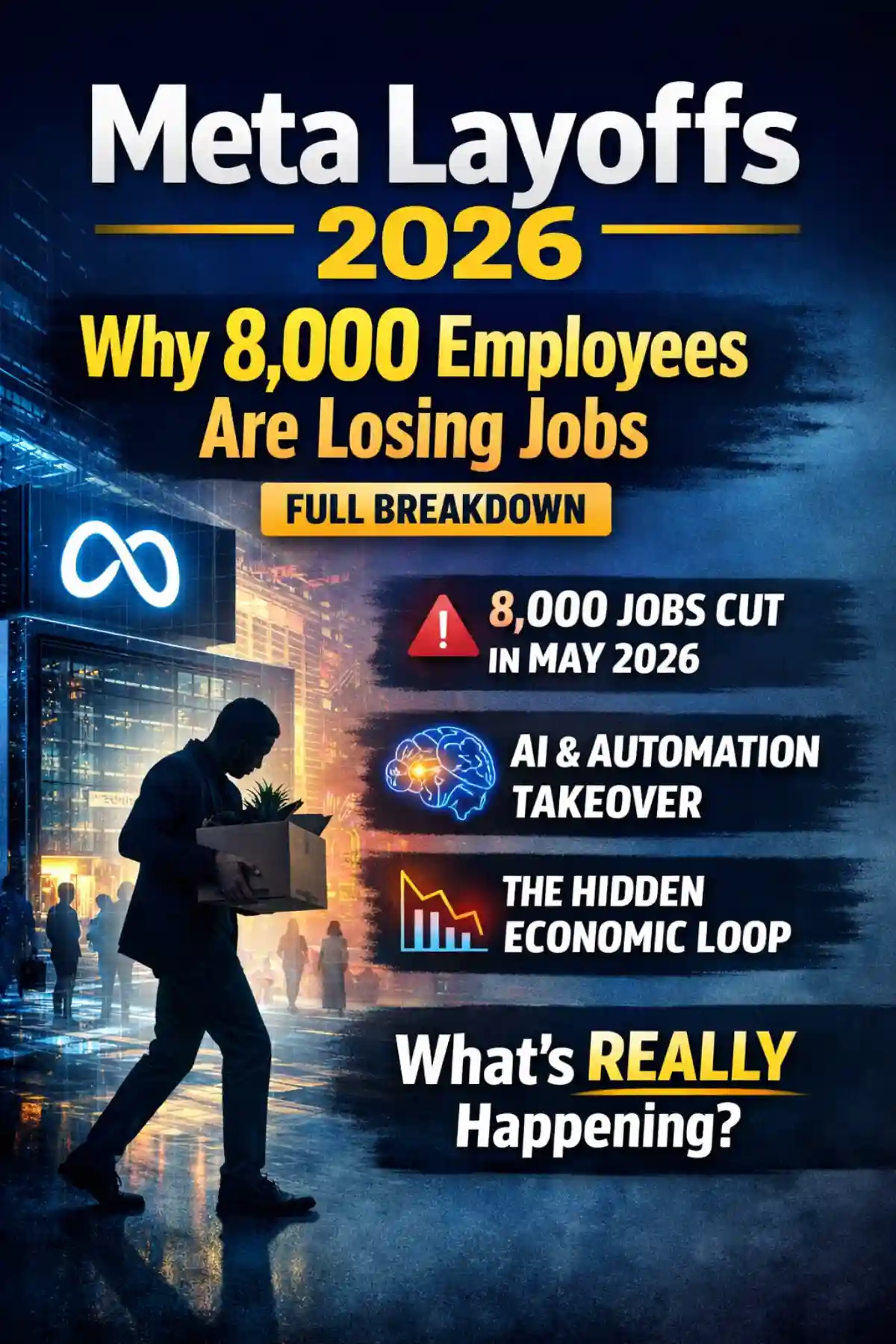
Meta Layoffs 2026: Why 8,000 Employees Are Losing Jobs (Full Breakdown and Hidden System)
The headlines are everywhere: Meta Platforms is cutting around 8,000 jobs in 2026.
Most articles stop at the obvious—cost-cutting, restructuring, and AI adoption. But if you actually dig deeper, the story is much bigger.
This isn’t just a layoff announcement.
It’s a signal of a system-wide shift in how companies compete in the AI era.
Let’s break it down properly.
What Happened: Meta Layoffs 2026 Explained
In early 2026, Meta confirmed a major workforce reduction:
- Around 8,000 employees affected with Meta Layoffs (~10%)
- Multiple phases expected through the year
- Focus on efficiency, AI integration, and leaner teams
At first glance, it sounds like a typical tech layoff cycle. But here’s the strange part:
👉 Meta is still profitable.
So why cut jobs?
The Real Reason: This Is Not Cost-Cutting by Meta Layoffs
Traditionally, layoffs happen when companies struggle.
That’s not the case here.
Meta is doing something different:
- Redirecting billions into AI infrastructure
- Reducing roles that can be automated
- Flattening management layers
This is closer to a strategic reset than a financial emergency.
In simple terms:
Meta is replacing parts of its workforce with systems that scale faster than humans.
The Hidden Concept: The “AI Layoff Trap/ Meta Layoffs”
Here’s where things get interesting.
A recent paper on arXiv (often referred to as the AI Layoff Trap) explains a pattern most people miss:
👉 Companies don’t adopt AI just because it’s better.
👉 They adopt it because their competitors are doing it.
This creates a chain reaction:
- One company automates
- Costs drop
- Competitors must follow
- Everyone automates
- Jobs disappear faster than new ones are created
This is called a competitive automation loop.
And Meta is right in the middle of it.
Why Meta Had No Choice
Think about Meta’s position.
It competes with:
All of them are aggressively investing in AI.
If Meta doesn’t:
- Its costs stay higher
- Its products evolve slower
- It loses competitive edge
So even if layoffs are uncomfortable, they become strategically necessary.
Where the Money Is Going Instead
Here’s the part most blogs ignore.
The money saved from layoffs isn’t just sitting idle.
It’s being redirected into:
1. AI Infrastructure
- Data centers
- GPU clusters
- Training large models
2. Automation Systems
- Internal tools replacing manual work
- AI-assisted coding and moderation
3. Product Intelligence
- Smarter ad targeting
- Personalized content algorithms
This is a capital shift from labor → intelligence systems.
The Surprising Truth: AI Isn’t Perfect Yet
Here’s the twist.
Research shows AI doesn’t always make things faster.
In many cases:
- Workers spend more time checking AI output
- Errors still require human correction
- Productivity gains are inconsistent
So why push AI so aggressively?
Because companies are optimizing for:
👉 future dominance, not current efficiency
Whoever builds the strongest AI systems today
→ controls the market tomorrow.
Which Jobs Are Most at Risk?
The layoffs aren’t random.
They’re focused on roles that AI can handle at scale.
High-risk roles:
- Repetitive coding
- Quality assurance (QA)
- Customer support
- Content moderation
Why these roles?
Because AI excels at:
- Pattern recognition
- Repetition
- Processing large datasets
Meanwhile, roles that involve:
- Strategy
- Creativity
- Complex decision-making
are safer—for now.
Industry-Wide Trend: It’s Not Just Meta
Meta is just one piece of a much larger shift.
Across the tech industry:
- Tens of thousands of layoffs in 2026
- Nearly half linked to AI adoption
- Companies restructuring for automation
This includes moves by:
- Snap Inc.
- Oracle Corporation
- Block Inc.
👉 This is not a company problem.
👉 It’s a system-wide transformation.
The Bigger Risk Nobody Talks About
Here’s where it gets serious.
If too many companies automate at once:
- Workers lose income
- Consumer spending drops
- Economic demand weakens
This creates a dangerous loop:
Companies cut jobs → people spend less → companies earn less
Researchers warn this could lead to a self-reinforcing slowdown.
So ironically:
👉 Layoffs meant to increase efficiency
👉 Could reduce long-term growth
The Talent Shift: Fewer Jobs, Higher Skills
Another major trend is happening quietly.
Top AI talent is moving into big tech companies like Meta.
What this means:
- Low-to-mid skill jobs shrink
- High-skill AI roles explode in value
- Income gap increases
In short:
The job market isn’t disappearing—it’s being restructured upward
What This Means for You
Let’s bring this down to reality.
The Meta layoffs are a signal of three things:
1. AI Is Reshaping Work, Not Just Replacing It
Jobs won’t vanish overnight—but they will change fast.
2. Stability Is Decreasing
Even big tech jobs are no longer “safe”
3. Skills Are the New Security
The only protection is adaptability
Final Conclusion: This Is Bigger Than Meta
Most articles say:
👉 “Meta is laying off workers because of AI.”
That’s too simple.
The real story is this:
AI is forcing companies into a competitive race where layoffs become unavoidable—even when companies are doing well.
Meta layoffs are not an isolated event.
They are a preview of how the global economy will evolve.
And if this trend continues:
👉 2026 may be remembered as the year work fundamentally changed.
About The Author
